


Medical strength equipment
Dr Wolff Back Therapy Centre - STANDING ROTATION 947

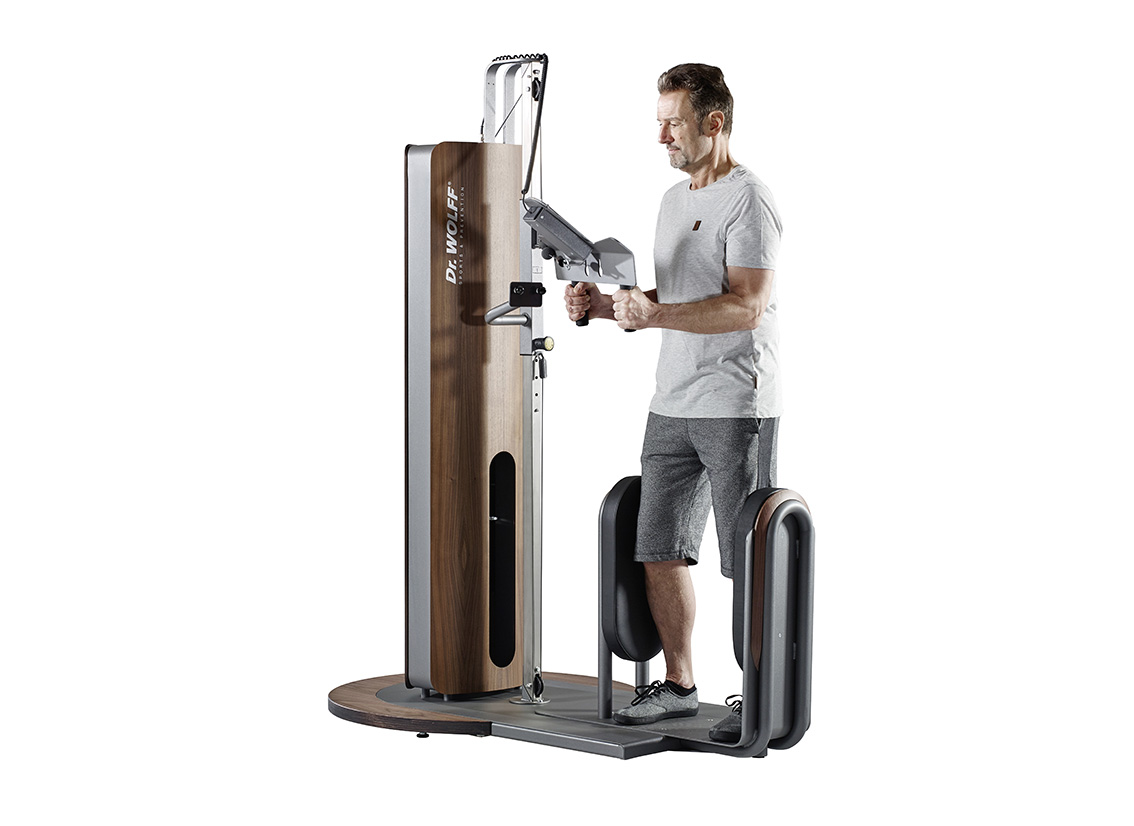

Product information "Dr Wolff Back Therapy Centre - STANDING ROTATION 947"
Rotation training
in an upright position
Biofeedback
Equipment technology
Dimensions:
Length: 162 cm / Width: 95 cm / Height: 197 cm
Segmental stabilisation
The current state of research in back therapy consistently shows that segmental stabilisation of the lumbar spine must take place before the actual strength training. The deep-lying transversus abdominis muscle and the multifidus lumbalis muscle are mainly responsible for the lumbar spine. These are not large, strong movement muscles, but rather sensitive positioning and holding muscles. They bring the individual vertebral bodies into the biomechanically correct position in order to protect the intervertebral disc from incorrect loading, for example.
Motor control of the lumbar spine
Many back patients have lost the important motor control of the lumbar spine. Practising coordinatively demanding movements in the Back Therapy Centre improves motor control and forms the basis for further training.
Training the deep muscles
The function of the transversus abdominis and multifidus lumbalis muscles has atrophied as a result of resting posture and permanent underload. Accordingly, training these deep muscles is of fundamental importance in modern back therapy.
Deep sensory training by Dr WOLFF
This is precisely where the Dr WOLFF concept comes in and differs fundamentally from conventional systems. Extremely small and coordinatively demanding exercises ensure that the transversus and multifidus muscles are activated.
The deep-seated, segmental stabilising muscles are activated on three levels:
- sagital - frontal - transversal
- sitting - lying - standing
The extraordinary device technology supports the therapist in the difficult task of reactivation: sensitive digital sensors record the small movements to be performed by the patient and document the training movement via an optical display unit. The key to success lies in the visualisation of the training movement and the exercise position:
- easy learning of the stabilising exercises
- quick "internalisation" of the movement sequences
- low-risk movements
- defined range of movement
- controllable from minimal, patient-appropriate to extremely high load intensity.
All devices comply: CE according to the Medical Devices Directive 93/42/EEC
The training media have been specially developed for segmental stabilisation of the lumbar spine according to Dr. WOLFF. An intelligent device design ensures biomechanically unique solutions (patented). Extremely simple and convenient operation facilitates patient instruction and independent training.